
Tomasz Robak on sight-reading, and why other instruments teach you more than other pianists
The pianist and Davidson College professor on reading below your level, ten minutes a day, the bass line and why you should keep your count going.
Tomasz Robak is a pianist and organist with a doctorate from the Peabody Conservatory, and a Fulbright award took him to the Karol Szymanowski Academy of Music in Katowice, Poland. He is an Associate Professor of the Practice in Music at Davidson College in North Carolina.
Here are thirteen of his best tips, from his Piano Star Masterclass on sight-reading on Piano League.
1. Read below your level
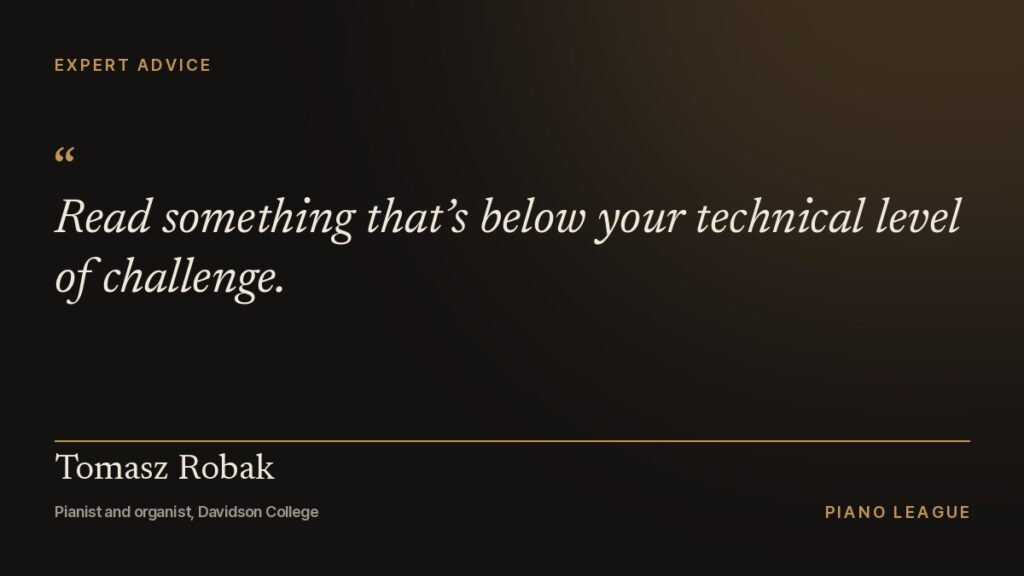
The general rule is that you try to read something that’s below your technical level of challenge. So if you’re playing a Clementi sonatina, you don’t want to be reading Beethoven’s Hammerklavier as a sight-reading exercise. On the other hand, if you’re at the level of playing a Beethoven sonata, then it’s perfectly appropriate to read some Clementi sonatinas as a sight-reading exercise.
Tomasz Robak
2. Ten minutes a day adds up
Something like 10 minutes into your practice session is not incredibly difficult to add, but it compounds over time tremendously. If you do this today for 10 minutes, you’re not probably going to feel like you’re a better reader. But if you do it today for 10 minutes and then you do it for the next three months, I guarantee you that three months from now you’re going to feel like you can read that level of literature that you were just reading much, much quicker and with less effort.
Tomasz Robak
3. Learn from singers and orchestras, not just pianists
I think listening to music that’s not piano music is crucial, because you get those ideas. The piano is really good at imitating other instruments, and composers often do that in their pieces as they try to have some idea in mind about a color or an articulation that comes from either string instrument or woodwind instrument. And for you to be listening to orchestral music or singers, you get a whole other idea about breathing and phrasing that you can then bring into your piano playing. I actually think we learn probably the most from listening to other instruments than we do from even listening to other pianists play.
Tomasz Robak
4. Keep your count going
I have to know how to play through a piece without stopping, and that’s a skill that we’re not made to practice when we’re practicing by ourselves. When we’re not performing with others, we tend to stop and correct. And another part of sight-reading is being able to get through the whole piece uninterrupted, even if you make a mistake, and just keep your count going.
Tomasz Robak
5. Pick a tempo you can keep, and look for traps first
Pick a tempo that you can get through reliably for the piece. And in order to be able to do that, you often have to kind of scan the piece. So you don’t just look at the beginning in the first page, but you open the score and you look through the piece. You see if there are any key changes, you look out for traps, any places that might look like they might already be trickier just by looking at them with your eye.
Tomasz Robak
6. Know what to grab first
Part of sight-reading also is being good at prioritizing what’s important, and that comes from a better knowledge of music and also from a good knowledge of theory. We know from most music until about 1900, we can bet that the bass line is going to be really important, and some kind of third in the harmony that will give us information, and then the melody.
Tomasz Robak
7. Read real pieces
Honestly, I think reading pieces is a little more satisfying. So if you can start reading pieces right away, you should. Any Baroque collections, kind of easy Bach, easy Handel, top hundred classical pieces, those kinds of collections.
Tomasz Robak
8. Sight-reading builds your technique too
Mozart pieces and Haydn and Czerny etudes are great for just learning some patterns. All this will help your technique, because you’re picking up a lot of patterns along the way that are hopefully being built into your system, especially if you read not just once but maybe a few times through.
Tomasz Robak
9. Train your ear and your theory
If your musicianship skills get better, if you work on sight-singing and if you work on learning your chords and your theory, you’re also going to be much better with your eye in terms of just quickly identifying what’s in front of you. And you’ll be able to send that signal faster to your hands and execute quicker the music that you’re trying to read.
Tomasz Robak
10. Listen with the score in front of you
If you want to get better at sight-reading, you should also listen as much as possible to different kinds of music, and preferably with a score in front of you so you can kind of follow along.
Tomasz Robak
11. Make it part of your warm-up
I think you can still do five to ten minutes. You can just use that as part of your warm-up. I think it’s a great way to just wake your brain up. In any case, if you’re about to sit down at the piano, play a few of your favorite technical things that you want to get warmed up, whether it’s scales or anything. You do that for five to ten minutes, and then another five to ten minutes on something new that you want to read, and then you can go and practice the rest of your repertoire.
Tomasz Robak
12. Start early
I think certainly it should be taught as early as possible. I think it’s a really important skill, and it should not be overlooked, especially in the early education of pianists. I know there’s so much that we need to do when we’re teaching pianists in the early levels, but I’ve found in all of my adjudicating, especially whenever there’s a sight-reading component, that tends to be pretty weak.
Tomasz Robak
13. Throw a sight-reading party
Later, as a teacher, you can add duets, certainly, which is always super fun, and doing that on the spot with them to kind of challenge them. And then maybe pairing students up for some kind of studio class sight-reading party, where people just kind of have fun with it and go with the flow.
Tomasz Robak
Quotes are lightly edited for length and clarity. They come from Tomasz Robak’s 2020 Piano Star Masterclass on sight-reading. You can watch the full masterclass on the Piano League YouTube channel.
Have a story tip or a correction? Tell us.