
Fei-Fei Dong on memorizing music as if every score were gone
The Cliburn finalist on memorizing early, fingering plans, mental practice and why your brain matters more than your fingers.
Fei-Fei Dong was one of six finalists at the 2013 Van Cliburn International Piano Competition. A graduate of The Juilliard School, she teaches piano at the John J. Cali School of Music at Montclair State University.
Here are thirteen of her best tips, from her Piano Star Masterclass on memorizing music on Piano League.
1. Don’t count on your fingers and ears on stage
It’s a really dangerous thing to rely too much on muscle and ear memory, because when we get on stage, we might physically get tense, or the audience might be noisy. So I think the brain is really the most important part of memorization.
Fei-Fei Dong
2. Start memorizing early, even though it’s harder
I personally like to start memorizing a piece sooner rather than later. I know this might feel more painful. The reason why I like to start memorizing early is because it forces me to not rely on the muscle memory and the ear memory to memorize the piece. It forces our brain to be more analytical, because it requires our brain to actively identify the patterns, identify the harmonies, to form the structure.
Fei-Fei Dong
3. Imagine every score in the world is gone
Sometimes I imagine if this is the end of the world and all music is destroyed. If I’m given a piece of music paper to write the music down, how much detail would I remember? Not only the notes, but all the markings by the composers. I think that’s how detailed we should try to study and memorize.
Fei-Fei Dong
4. Memorize more than the notes
I feel like we should start right away memorizing music very accurately, meaning we are not just memorizing the notes. So right away I would study those small sections really thoroughly, and look at the articulation, the dynamics, the phrasing, the rests, the pedaling, everything.
Fei-Fei Dong
5. Fingering is choreography
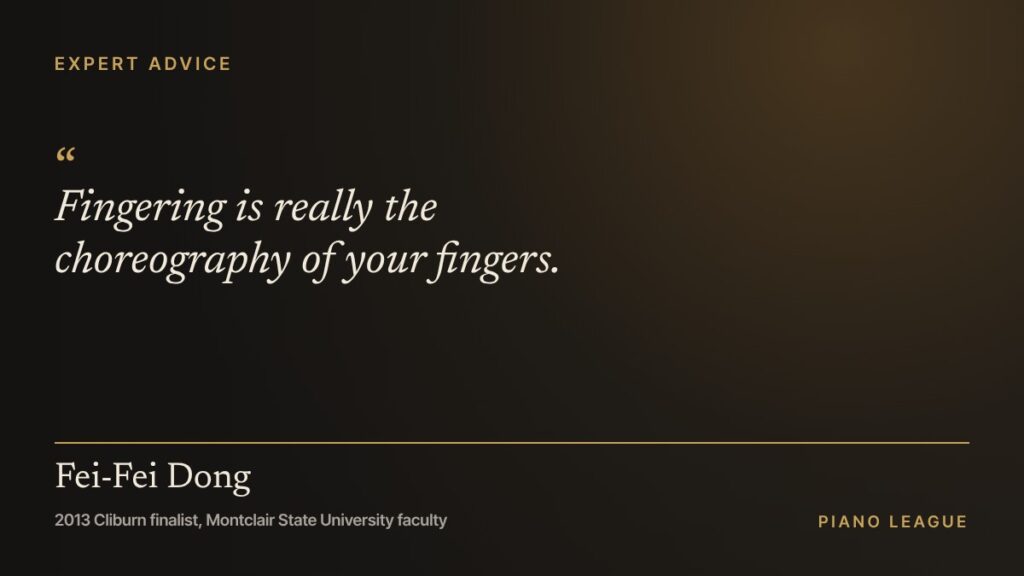
I feel like laying out a very well-thought-out fingering plan at the beginning of your learning process would help you practice better, because fingering is really the choreography of your fingers. If you find and commit to a good fingering plan, I think that really helps strengthen your muscle memory.
Fei-Fei Dong
6. Play it in your head first
What I usually do is mental practice away from the instrument. Of course that includes score study, and also, actually, I learned this from Sean Chen. He told me what he would do is sit, close his eyes and go through the music in his head, as if he’s seeing the music in his mind. And of course, it’s quite difficult. It’s more difficult than it sounds. Sometimes you get stuck, then you check the score, you clarify it, and then you go back to it and continue.
Fei-Fei Dong
7. Practice with your eyes closed
I also do a lot of weird exercises. Sometimes I practice with my eyes closed. I think that way, without seeing the keyboard, we force our ears to really listen more, and also it breaks down our muscle memories a little bit. Sometimes I listen to a recording and just go through the music in my head with the recording.
Fei-Fei Dong
8. Memorize when your mind is freshest
Use your most productive time to memorize music, because I feel memorization takes and requires so much concentration. So I would recommend structuring our practice time in such a way that we are using our freshest mind and most energetic hours to memorize music.
Fei-Fei Dong
9. Old fingerings bring a piece back
Another thing I noticed is when you have put down some fingering plans and you decide to leave the piece for a while, when you come back to it and you can see some old fingerings in your music, for me that really triggers the muscle memory and makes relearning much quicker and easier.
Fei-Fei Dong
10. Read it through, then break it into small chunks
Of course, when I start learning a piece, I read it through a few times first, just so we know how this piece as a whole looks. But my next tip for memorization would be: really break the piece down to small sections, small chunks, either by movement, by sections, even by phrases, whatever makes sense for you and for the music.
Fei-Fei Dong
11. Memory is a muscle you can train
I really think memorization is like working out in a gym. It’s really like exercising, so the more we do it, the more we exercise our brain, the better and faster and more comfortable we get doing it.
Fei-Fei Dong
12. Memorize Bach
I try to encourage them to play more Bach, for sure, just because I think Bach was also a great choice of composer to do that kind of exercise, because his music just requires the utmost clarity of the player’s mind.
Fei-Fei Dong
13. Memorization is not the goal
Every person’s brain works so differently, and every musician has a unique way of approaching new music. I think we always have to keep in mind, especially for students and some adult students, memorization shouldn’t be a goal that we try to achieve. It’s just something that helps us know the piece better.
Fei-Fei Dong
Quotes are lightly edited for length and clarity. They come from Fei-Fei Dong’s 2020 Piano Star Masterclass on memorizing music. You can watch the full masterclass on the Piano League YouTube channel.
Have a story tip or a correction? Tell us.