
Lindsay Garritson on competitions, and why one piece can count against you
The Cliburn competitor on choosing competitions and repertoire, judges' opinions, staying focused on stage, and why you should never compete with a brand new piece.
Lindsay Garritson is an American pianist who was one of 30 pianists invited to the 2013 Van Cliburn International Piano Competition. Her Carnegie Hall solo debut included the world premiere of Carl Vine’s Piano Sonata No. 4, which was written for her.
Here are fourteen of her best tips, from her Piano Star Masterclass on preparing for competitions on Piano League.
1. Bring more than one piece
The other thing I would always look for with repertoire, what to choose, is look for variety. Depending on time limits or whether there are repertoire requirements, you always want to make sure that you can do at least more than one piece if possible. And the reason I think that’s important is because not only does it show that you have a variety of different eras, different composers, but with judges who probably have strong opinions about either a composer or a particular piece that you might be playing, if you’re only playing that one piece and the judge or judges might not agree with your interpretation, that can actually count against you.
Lindsay Garritson
2. Never compete with a brand new piece
I would say the most important thing, no matter what you’re doing, is to make sure you’re not playing things that are brand new or things that you haven’t had opportunities to perform, because there’s so many kinds of pressures that are not the same as just preparing for a performance. You want to make sure that you’re as comfortable as possible with whatever repertoire you’re playing.
Lindsay Garritson
3. Make a plan with your teacher
No matter what, always talk to your teacher first before doing competitions, and really make a strategy or a plan, because you want to make sure that you are preparing for competitions for your short-term goals as a pianist and your long-term goals, and you want to find the right competitions for where you are at any given point.
Lindsay Garritson
4. Small mistakes decide close results
When you have pianists at such a high level, and these days there are so many great pianists at all different levels of competitions, when it comes down to it, judges are probably going to choose the person who didn’t have as many superficial mistakes. It doesn’t mean that this pianist is better than this one, but there are more superficial things that you have to be more aware of as you’re preparing.
Lindsay Garritson
5. Let a competition make you read every marking
It is great to force yourself to look at all the details of the score of whatever piece you’re playing, which is ideal whether it’s a performance or a competition, and just looking at what the composer has written: dynamics, articulation. Sometimes it’s easy to gloss over some of those things when we’re just preparing for a performance, but when it’s a competition, you want to do as well as possible, you’re going to look at all the details, be as clean as possible.
Lindsay Garritson
6. Practice with stage focus
You want to get to a place in your practice where you have complete focus and try to replicate what it feels like on stage. Obviously you can’t completely replicate how it feels on stage, because you probably don’t have people in front of you when you’re practicing, but there is a certain amount of focus that you can practice when you go to the keyboard, when you’re warming up in the morning even.
Lindsay Garritson
7. Practice starting from the middle
That actually ties into competitions where you might have a judge who says, okay, I’d like you to start from the middle of the piece, and then you play maybe a section of a piece without the whole thing. As you can imagine, that is very difficult to do mentally, to be focused in those moments, and that’s why practicing, maybe jumping around, trying to replicate what that’s going to feel like, that’s really important.
Lindsay Garritson
8. Sift the judges’ comments
There is merit in taking that critique and deciding, okay, maybe this is something that could make my playing better. It’s really great to listen to judges’ critiques and deciding what is the good and what is the stuff that, frankly, I’m not gonna listen to because it doesn’t make sense to me.
Lindsay Garritson
9. Treat every competition as a lesson
Treat competitions like a learning experience, as cliché as that might sound. That’s really the most healthy way you can look at them, no matter what your age is, how good you are, what level you’re at at the moment. Really just treat competitions as a way to get better as a pianist, to push yourself to look at all the details, to get your technique better and to perform better.
Lindsay Garritson
10. Play like an actor projecting to the back row
It’s just like if you were an actor on a stage and you have to project whatever you’re saying. It’s not going to be loud enough as if you’re just talking to somebody in front of you. So when you’re performing, it’s the same thing. Everything you do has to be slightly exaggerated so the person at the back of the hall can hear what you’re trying to convey in the music.
Lindsay Garritson
11. Count out loud
Part of the good thing about counting out loud, hard as it is to coordinate everything, it really makes you aware of if you are changing tempos anywhere, because you have to kind of say everything out loud. So I would say if you could practice at home counting out loud, even if it’s a very slow tempo, counting out loud the whole piece, what that will do is solidify your tempo as you get faster.
Lindsay Garritson
12. Every rest has a reason
All different kinds of composers will decide in particular moments to either write a fermata on a note, or a fermata on a rest, or a rest, and there’s always a purpose to those moments of pause, or silence, let’s say. And so it’s your job as the performer to figure out why.
Lindsay Garritson
13. Stay close to the keys for soft chords
As a general rule, when you want to play a chord softer, stay closer to the keys.
Lindsay Garritson
14. Only you can say what you have to say
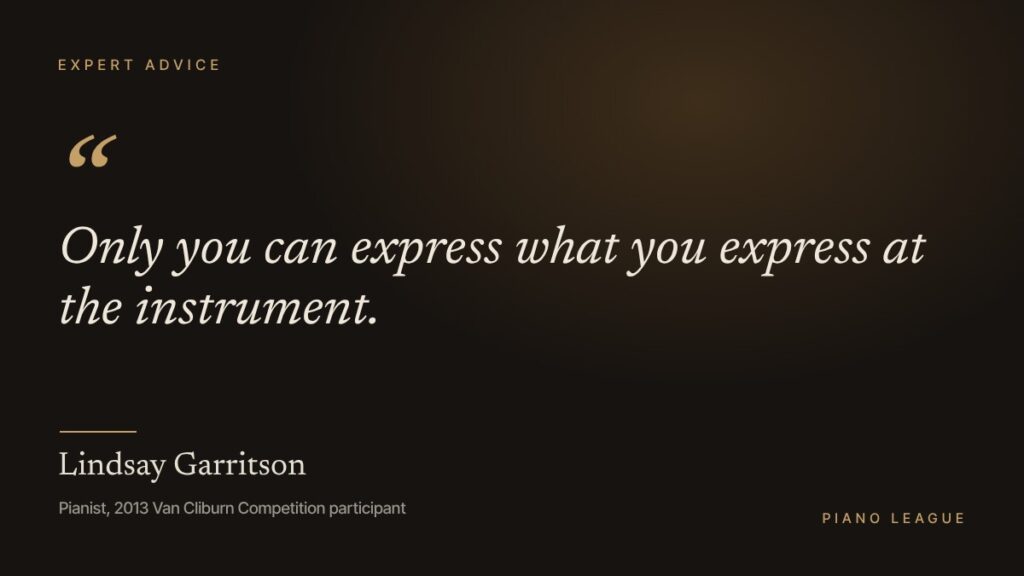
The way I think about it is that we’re all unique. We all have something to say as musicians, and if piano and music is your passion, you will find a way to make it work. You’ll find your path. Only you can express what you express at the instrument with music.
Lindsay Garritson
Quotes are lightly edited for length and clarity. They come from Lindsay Garritson’s 2020 Piano Star Masterclass on preparing for competitions. You can watch the full masterclass on the Piano League YouTube channel.
Have a story tip or a correction? Tell us.