
Elena Nezhdanova on teaching technique from day one, and why relaxed doesn’t mean noodle fingers
The pianist and Hamilton College teacher on a free arm, peanut butter keys, real pianos and why good habits start in the first lesson.
Elena Nezhdanova is a Russian-born pianist and a lecturer in piano at Hamilton College. She holds a doctorate from UNC Greensboro and co-founded the Nezhdanova-Placzek Duo with cellist Roman Placzek.
Here are fourteen of her best tips, from her Piano Star Masterclass on teaching piano technique from the start on Piano League.
1. Relaxed doesn’t mean noodle fingers
It’s not like relaxation that you will let your fingers be like noodles. No, we’re not talking about it. You should be able to sustain the weight, the natural weight of the arm, all the way from shoulder on one fingertip.
Elena Nezhdanova
2. Think of your arm as a garden hose
We’re talking about free arm. The energy’s got to flow to the fingertips. So think about our arm being like a hose. Like when you water flowers in the garden, for example, what happens when you step on the hose? You water, water, water, whoop, somebody steps on there. What’s going to happen? The water flow stops, right? So imagine that this tension is what kind of stops the sound from flowing.
Elena Nezhdanova
3. Dip into the key like it’s peanut butter
You’ve got a jar of peanut butter. It’s soft and squishy. How would you dip your finger into it? Or honey. So it’s slow. We’re listening to the duration of the sound, and then we’re gently lifting.
Elena Nezhdanova
4. Anyone can poke a note. Good habits start in lesson one
If you think about it kind of jokingly, you could come up, take a pencil, poke at a note, and it gives you a lovely little note. And then when you take all five of the little sticks, fingers, you can go play a little song, and there you go, you play piano. But, putting jokes aside, I realized that a lot of initial preparatory work must be addressed from the very beginning and continued for future lessons, to build on new habits.
Elena Nezhdanova
5. Learn on a real piano if you can
In our ideal world, I would love every piano kid to have access to an acoustic instrument. It does not have to be a baby grand or a Steinway, but just a good, solid upright piano, to understand the mechanics of it. So when the hammer hits the string, the sound originates there. Unfortunately, keyboards, no matter how weighted they are, just don’t work the same.
Elena Nezhdanova
6. Lead with the wrist, and never force
Once they’re able to play on the tip of the finger without collapsing the joint, which is another common mistake, we want to dip the finger into the key by not breaking the wrist too much, and with the leading of the wrist we want to let go, or lift it up. And it has to be very gentle. Not pushing, not squeezing, not forcing, but very natural.
Elena Nezhdanova
7. Correct kindly, and right away
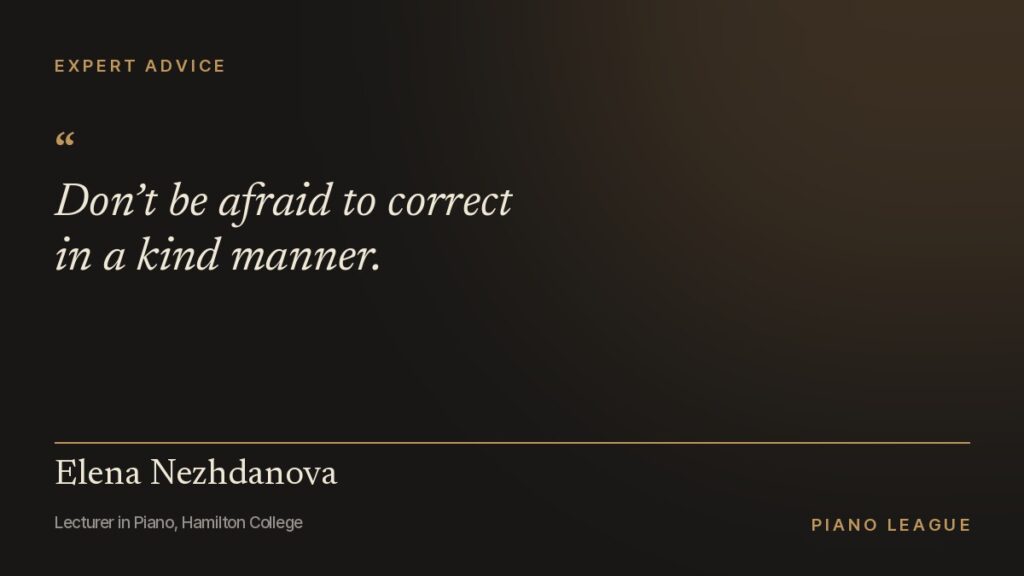
If the student starts to force the sound, and I do notice it quite a lot, they feel awkward and they’re not quite sure what they’re supposed to do. So let them experiment, but don’t be afraid to correct in a kind manner. Don’t say, oh, you got it all wrong. Make them feel comfortable.
Elena Nezhdanova
8. Practice slowly, and detached
Play even hands separately in a slow tempo, but I want to say, like, a detached sound, a little bit like a non legato, so you really know exactly where your fingers are going on all of those chords and those little gestures. So when you’ve solidified it in slow tempo, keeping in mind the free arm and breathing, when you do it in fast tempo, hopefully it will feel easier to play.
Elena Nezhdanova
9. Don’t ignore what feels uncomfortable
Of course, the essence is music, so we’ve got to learn how to interpret what’s on the page. But if we’re also a nervous wreck and things feel uncomfortable, and we don’t address it and don’t fix it, that creates a lot of technical problems, almost leading to injuries actually.
Elena Nezhdanova
10. Open the piano on day one
Absolutely from day one. They walk into a studio: hello, how are you, let’s explore the piano. I’m not afraid to actually show kids the inside of the piano, because that’s the first thing they want to see.
Elena Nezhdanova
11. Give children words for what they hear
I would say introduce your kids and your students to classical music as early as possible. Do a lot of listening games. It actually makes a lesson go by more productively. Have them draw a picture, have them write a story, so they learn and gain the vocabulary needed later on to express themselves through music.
Elena Nezhdanova
12. Teach relaxation as a game
You have to turn it into a game. One of my favorites is, let’s pretend we are Santa Claus holding the reins. So you tighten your hand, stretch your arms, and then you let go. So which one feels better, tight, forced, or relaxed?
Elena Nezhdanova
13. Sing the note with your student
I personally also like to sing with my students. When we’re doing these very simple exercises, even just on the black keys, sing on a neutral pitch and see how your voice starts the note, continues, and then your voice lets go.
Elena Nezhdanova
14. Give dangling feet somewhere to stand
You do need to have a footstool or a pedal extender. So if the kid cannot naturally plant their feet on the ground and they’re dangling them, you absolutely must have something solid to have them plant their feet.
Elena Nezhdanova
Quotes are lightly edited for length and clarity. They come from Elena Nezhdanova’s 2020 Piano Star Masterclass on teaching piano technique from the start. You can watch the full masterclass on the Piano League YouTube channel.
Have a story tip or a correction? Tell us.