
Robert McDonald on playing on the front side of the beat
The Juilliard and Curtis teacher on rhythm, silence and reacting to every harmony.
Robert McDonald teaches at the Juilliard School and the Curtis Institute of Music, and is artistic director of the Taos School of Music in New Mexico. He won the gold medal at the Busoni International Piano Competition and was Isaac Stern’s recital partner for many years. His former students include Eric Lu, winner of the 2025 Chopin Competition.
Here are fourteen of his best tips, taken from feedback he gave young pianists after live performances, with a link to each moment on video.
1. Play on the front side of the beat
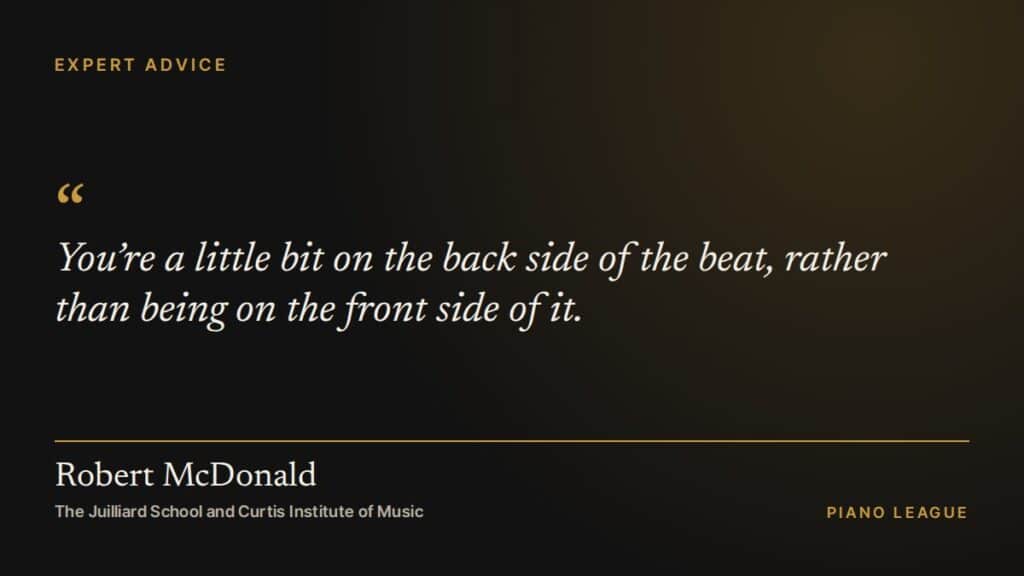
Sometimes to a student I’ll say, you’re a little bit on the back side of the beat rather than being on the front side of it, or even right on top of it. Those are the things that will make a difference in how your control of tempo comes through.
Robert McDonald
2. Don’t let the accompaniment drag the melody
Try not to slow down on the weak beats of the accompaniment. They should not be emphasized in any way that pulls the unfolding of the line backwards.
Robert McDonald
3. Pianissimo can mean inward, not just soft
Often people, in an effort to play cantabile, forget that in comparison to the first theme this one is that much more inward.
Robert McDonald
4. Silence creates the tension
Make sure the bravura side of the music has enough inner tension. That’s always determined by how you handle the silences.
Robert McDonald
5. React to every new harmony
When you arrived on those harmonies, your reactions were too similar. Ask yourself each time what spontaneous reaction you feel, whether the chord is major, whether it is minor, whatever it happens to be.
Robert McDonald
6. Read the composer’s words closely
When a composer writes “leggierissimo” rather than just “leggiero,” he said, that is a choice.
If the composer writes the comparative form of that word, he or she has something very specific in mind.
Robert McDonald
7. Find the pulse in the left hand
Your sense of how you guide the notes needs to be governed by a stronger feeling of the pulse, and that’s always most easily addressed by paying attention to how you would phrase the left hand.
Robert McDonald
8. Even free passages have strong and weak beats
Where Chopin encourages a kind of cadenza-like freedom, make sure everything is still delineated within yourself: where the strong and weak inflections are in any phrase.
Robert McDonald
9. Check in emotionally
Think about how one thing logically leads to the next. You also have to check in emotionally more often and ask: does this phrase tie to that phrase? You could call it an inner logic.
Robert McDonald
10. Bend time, but don’t stop it
Be careful that those timings don’t break up the train of thought. What’s the difference between bending time and stopping time? Respect the natural sense of momentum written in the music.
Robert McDonald
11. Spell out the cadences
Make certain that wherever the important cadences are, you spell them out to your listener as clearly as possible. They define how the sections of the piece are constructed.
Robert McDonald
12. A return is a continuation
It’s not starting over. Keep that in mind: it’s continuing.
Robert McDonald
13. Chopin is the most contrapuntal of composers
With this most contrapuntal of composers, please pay as careful attention to your left hand and its purpose as you do to the right.
Robert McDonald
14. Find the narrative
The sense of a narrative for the music could be stronger. Think about how the piece begins, how it gradually adds layers, and how its shape becomes clear to us.
Robert McDonald
Quotes are lightly edited for length and clarity. They come from Mr. McDonald’s comments as a judge at the 2022 and 2024 Piano Star International Competition. You can watch the full performances and feedback on the Piano League YouTube channel.
Quick question
Which of these will you listen for this week?
Have a story tip or a correction? Tell us.