
Rachel Naomi Kudo on why your scales should sing
The Gilmore Young Artist on scales, waltzes and the markings Chopin chose most carefully.
Rachel Naomi Kudo received the Gilmore Young Artist Award in 2008 and won first prize at the International Johann Sebastian Bach Competition in Leipzig. She has performed as a soloist with major orchestras and has hosted the livestreams of the Cliburn Junior International Piano Competition and the U.S. National Chopin Piano Competition.
Here are eight of her best tips, taken from feedback she gave young pianists after live performances, with a link to each moment on video.
1. Make your scales sing
My teacher had me play scales at the beginning of every lesson. The difficult thing with scales is to play legato, in a smooth line.
Rachel Naomi Kudo
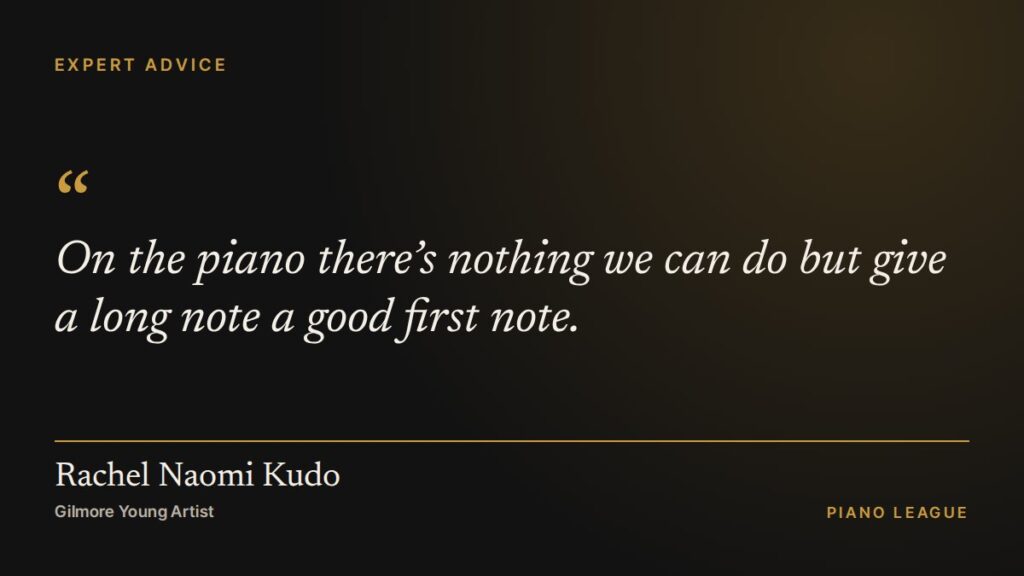
2. Give a long note a good start
A lot of times we have long sustaining notes, and of course on the piano there’s nothing we can do but give it a good first note.
Rachel Naomi Kudo
3. When the hands take turns, let the left hand speak
When the voices alternate between the right and the left hand, I noticed the right hand was perhaps a little more prominent. When the voices are equal, consider the left hand a little more. Sometimes the notes don’t have to end so short.
Rachel Naomi Kudo
4. A waltz is a dance, so linger
Your rhythm was wonderful, but it is a waltz, a dance, so there’s time to linger here and there.
Rachel Naomi Kudo
5. Imagine the ballroom
Envision a ballroom with beautiful gowns, something very formal but at the same time alluring, romantic and elegant. Open up your imagination. Not every waltz has to be in the same even tempo and the same mood.
Rachel Naomi Kudo
6. Look for the rare markings
In a famous Chopin etude, she pointed to the few quiet bars in a loud piece.
Chopin was such a detail-oriented composer, very specific in what he indicated. There are just a few moments, two bars here and two bars there, where he marks piano, and those are actually quite special.
Rachel Naomi Kudo
7. Don’t rush the rests
Don’t rush the rests. Where a phrase ends or there’s a pause, you can take a little more time. It doesn’t need to rush on.
Rachel Naomi Kudo
8. Finish each phrase before starting the next
Pay even more attention to things like the ends of phrases, taking care of certain things before moving on to the next phrase.
Rachel Naomi Kudo
Quotes are lightly edited for length and clarity. They come from Ms. Kudo’s comments as a judge at the 2023 Piano Star International Competition. You can watch the full performances and feedback on the Piano League YouTube channel.
Quick question
How do you usually warm up?
Have a story tip or a correction? Tell us.