
James Giles on why you should practice staccato legato
The Northwestern piano professor on pulse, the left hand, dissonance and keeping a familiar piece fresh.
James Giles is professor of piano and head of the piano program at Northwestern University’s Bienen School of Music, and artistic director of the Amalfi Coast Music Festival. He gives master classes at schools across the United States.
Here are ten of his best tips, taken from feedback he gave young pianists after live performances, with a link to each moment on video.
1. Practice staccato legato
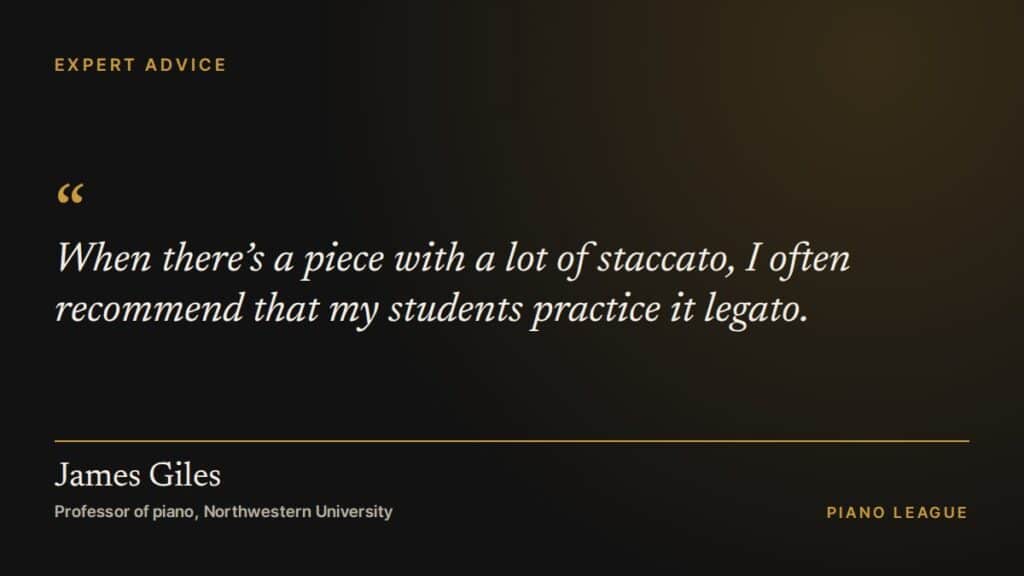
When there’s a piece with a lot of staccato, I often recommend to my students that they practice it legato, and perhaps a little under tempo. It’s very easy to play very short, but also easy to lose the sense that music moves horizontally.
James Giles
2. The left hand is an equal partner
Often you treat the left hand as more of an accompaniment. It could be a little more prominent: a line that’s not just supportive, but an equal part to what you’re doing in the right hand.
James Giles
3. Know where the pulse is
Make sure that we feel the pulse is in four and not in eight, so the smaller note values don’t start subdividing the bar into too many sections.
James Giles
4. In three, the beats are not equal
In any piece that’s in three, you want to make sure the three quarter notes are not given equal weight. The more you study waltzes, you’ll notice how third beats tend to be upbeats to the following downbeat.
James Giles
5. The singer always leads
Remember that the singer always leads. It’s not always sung, but it’s the leader: the voice with the melodic material.
James Giles
6. Speak as well as sing
We very often talk about singing at the piano, but some pieces need to be spoken and sung at the same time, almost like there are consonants as well as vowels on some of the notes.
James Giles
7. Give dissonance its moment
Be particularly aware of dissonant notes that happen on strong beats. A dissonance on a strong beat perhaps needs a little more preparation, or a tenuto, something a little more special.
James Giles
8. Keep the texture balanced as you grow louder
When you make crescendos, keep the balance of the three levels of the texture: melody, middle and bass. Sometimes everything comes up the same way and it becomes thick in the middle.
James Giles
9. Remember what a steady pulse feels like
On Beethoven’s Sonata in E-flat major, Op. 31 No. 3:
It might be a good exercise to remind yourself what it feels like to play with an absolutely steady pulse, because the rhythm, as in so much of Beethoven, is so vital.
James Giles
10. Keep a familiar piece fresh
Maybe it’s the sort of piece you want to try not to play the same way every time, even though you know it well. Try to think of new ways to highlight things, so that you stay very interested in it.
James Giles
Quotes are lightly edited for length and clarity. They come from Mr. Giles’s comments as a judge at the 2025 Piano Star International Competition. You can watch the full performances and feedback on the Piano League YouTube channel.
Quick question
Which tip will you try this week?
Have a story tip or a correction? Tell us.