
David Fung: “The music of Beethoven plays itself”
The Manhattan School of Music pianist on why forcing tempo, bravura and volume works against you.
David Fung teaches at the Manhattan School of Music and the University of British Columbia, and curates the Spirio piano series at the Chan Centre in Vancouver. He has appeared as a soloist with orchestras including the Cleveland Orchestra, the Los Angeles Philharmonic and the San Francisco Symphony.
Here are thirteen of his best tips, taken from feedback he gave young pianists after live performances, with a link to each moment on video.
1. Let Beethoven play itself
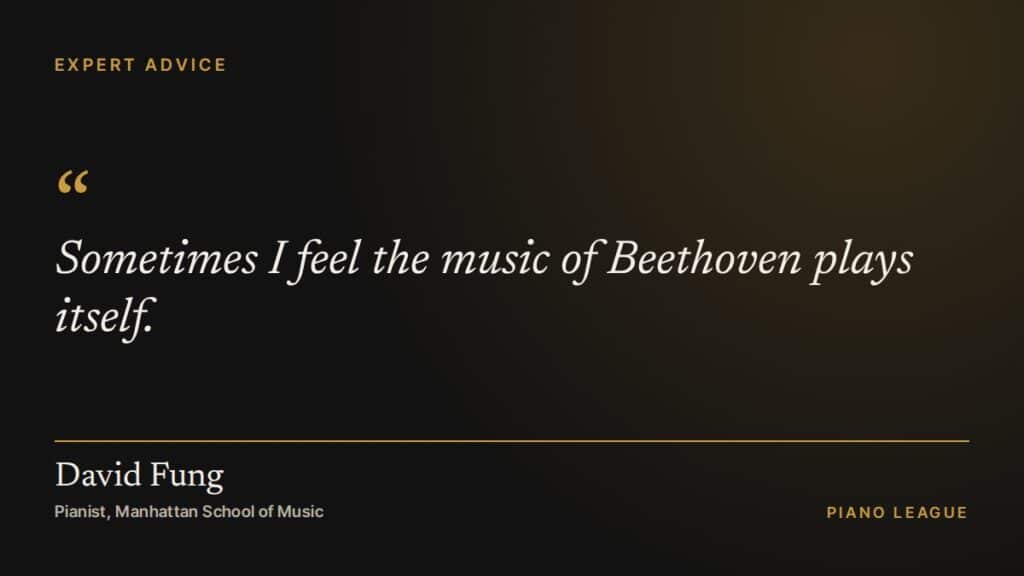
Sometimes I feel the music of Beethoven plays itself, and we don’t always need to over-manufacture the tempi and the transitions. He’s a very deeply thoughtful composer when it comes to structure.
David Fung
2. Balance every layer
On Glinka and Balakirev’s The Lark, where the melody is surrounded by accompaniment and filigree:
I wished for a clearer sense of balance between the lines you have to deliver throughout this work: the main vocal material, the counter melody, and the way you weave the thirty-second notes underneath the melody.
David Fung
3. Let the intervals guide your rubato
I like to almost imagine a line connecting your intervals, so that we really hear the space between the notes. Let that guide you with how much time you take.
David Fung
4. Find the median tempo
Have a judicious sense of what the median tempo is between the sections, so that we have a very nice transition that doesn’t fluctuate too much in tempo.
David Fung
5. Don’t forget to play softly
On Schumann’s Abegg Variations, Op. 1:
One of the things I wished for more was softer playing. Schumann marks parts pianissimo, and I don’t always hear that level of shape that he builds into his writing.
David Fung
6. Technique serves the music
I wanted to caution you against using technique for the sake of bravura. It should always be used to further the musical shape or the musical intention.
David Fung
7. Hear the harmonic hierarchy
The piece begins with a dominant chord, then a pre-dominant, then a dominant and then the resolution. With greater awareness of that harmonic hierarchy, the shaping doesn’t all sound the same.
David Fung
8. Some things take listening and experience
On the lilt of the mazurka in Chopin’s Rondo à la mazur, Op. 5:
That beautiful lilt on the second beat is such a difficult feeling to capture. It’s really something that requires a lot of listening and a lot of experience.
David Fung
9. Small hands: stay close to the keys
If your hand is not quite large enough to play the octaves legato with fingered octaves, stay a little closer to the keys. More shaping in those lines can hide the lack of legato fingerings at this stage of your development.
David Fung
10. Sing every note, even the small ones
If you sing every note, we will enjoy it so much more. Even the smallest notes can be treated in a very operatic way.
David Fung
11. An accent can be time, not volume
When accents are marked, we can consider treating them with time, to create stress, rather than with actual dynamic intensity.
David Fung
12. High notes always project more
We have to remember that the highest pitches on the piano always project more, so work even harder to make sure the speed at which you play those notes is greatly reduced.
David Fung
13. Let your arm move in a circle
Consider a more horizontal motion from the bass to the chords above, and then release on the higher chord, so that your arm is performing a circular motion.
David Fung
Quotes are lightly edited for length and clarity. They come from Mr. Fung’s comments as a judge at the 2025 Piano Star International Competition. You can watch the full performances and feedback on the Piano League YouTube channel.
Quick question
Which of these do you want to work on?
Have a story tip or a correction? Tell us.