
Magdalena Stern-Baczewska on why Bach’s inventions are floss for your brain
The Columbia pianist on singing at the keyboard, offbeat motifs, staccatos, cadences and why Bach's inventions keep you honest.
Magdalena Stern-Baczewska is director of the Music Performance Program at Columbia University and artistic director of the Kosciuszko Foundation Chopin Piano Competition in New York. Her doctoral dissertation, In Search of Bach’s Cantabile, explores the role of oratory and singing in keyboard playing.
Here are fourteen of her best tips, from her Piano Star Masterclass on Bach’s Two-Part Inventions on Piano League.
1. Come back to the inventions to clear your mind
These 15 pieces, I always think of them as kind of a floss for your brain, as well as for your ears. They always keep you honest. I certainly always come back to these pieces in order to clear my mind and really come back to what’s important in music.
Magdalena Stern-Baczewska
2. Ask what each piece will teach you
I think that as performers, at any age, at my age, I still learn from these pieces. I think we approach each piece asking ourselves, what is this going to teach me? What is Bach telling me that’s new that I should know about music?
Magdalena Stern-Baczewska
3. Use the piano like your voice
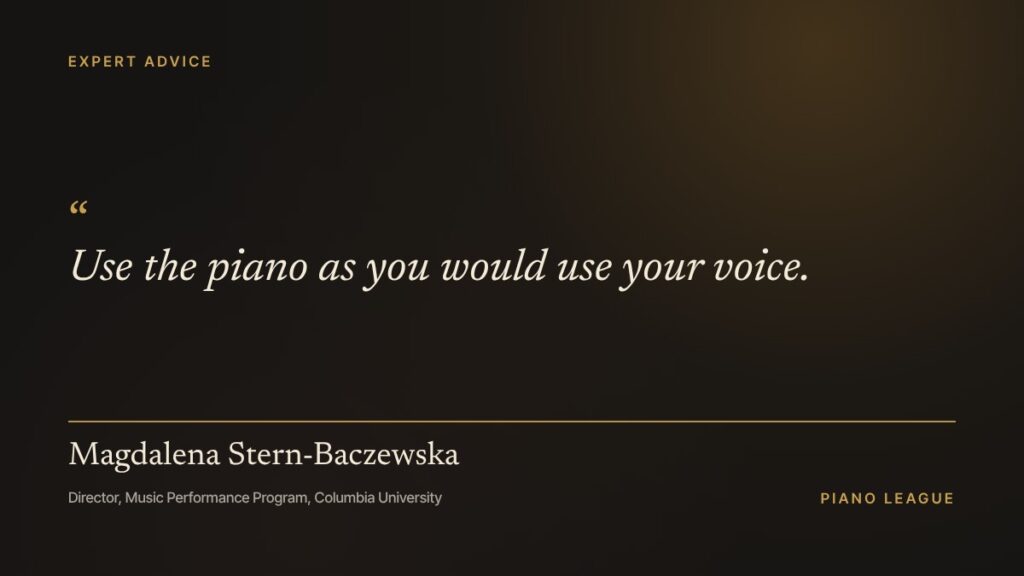
My first piece of advice is, when you pick up the invention, take advantage of the piano and all the capabilities dynamically that it has. So use the piano as you would use your voice.
Magdalena Stern-Baczewska
4. Crescendo when the melody climbs
When the melody goes up, that’s something that Pablo Casals actually talked about. Famous cellist, but it applies to piano too. He said when the melody goes up, simply make a crescendo, as though you were a singer letting more air into your lungs in order to be able to climb that melody.
Magdalena Stern-Baczewska
5. Don’t get stuck on the downbeat
He teaches us to not get stuck on the downbeat, because his first melody of this volume starts on the offbeat, on the second sixteenth note of the measure. And you will see that almost all fugues in the Well-Tempered Clavier, for example, start on some sort of an offbeat or upbeat. And that shows us so much about how to contour the melody, how to follow its shape.
Magdalena Stern-Baczewska
6. Don’t rush past the inventions to the fugues
What happens often with young students, they are so excited about playing Bach, and obviously they want to immediately go on to the fugues. But Bach says, wait a minute, I have all the lessons that you need right here. So if you just learn the first invention, you learn so much about the motivic workings of the piece, which prepares you for the fugues.
Magdalena Stern-Baczewska
7. The score is not a museum piece
There’s this camp of teaching, for example, well, if Bach didn’t write this trill or a mordent on this page, one should never even touch it, because this music is so revered now, and we almost treat it as something sacred, almost like a museum. But for Bach it’s the opposite. For him, this is the mere record of the work, saying, here it is, now do something creative with it.
Magdalena Stern-Baczewska
8. Don’t become a typist
It’s very easy to rattle things off on the piano, as long as your fingers are working nice and fast. It’s very dangerous, because we can quickly just become a typist. So make sure you breathe on the keyboard and articulate the way you would speak.
Magdalena Stern-Baczewska
9. Recognize the dance
At a certain point you get so fluent with this that you just look at the page and you say, oh yes, that’s a bourrée, or that’s the minuet, that’s the gigue. And that immediately brings a certain kind of choreography to mind, and the lightness with which this music should come.
Magdalena Stern-Baczewska
10. Vary the length of your staccatos
What one must do is to vary the length of these staccatos. So you would go from a slightly more sluggish to a very sharp and short staccato, to create a feeling of energy rising.
Magdalena Stern-Baczewska
11. Give the motif words
What I also like to do when I teach this invention is to think of words that would go with it. And I think that’s totally fine to do, because Bach would write music that’s instrumental, and then you would hear the very same kind of motif in his vocal works, with words.
Magdalena Stern-Baczewska
12. Use every cadence to exhale
Every time you have a nice cadence, a dominant tonic or just five one in any key, use it as a moment of repose. It’s your punctuation. It’s at least a comma, if not a period. So look for cadences and take them as an opportunity to exhale.
Magdalena Stern-Baczewska
13. Start less when there is room to grow
Whenever you have this kind of material where there is room for growth, start a little less. You will get more enjoyment out of it, and your audience will be more excited too.
Magdalena Stern-Baczewska
14. When in doubt, sing it
I never stop singing when I teach or when I practice, because my voice is dictating to me how to phrase. And in fact, it was Bach’s son Carl Philipp Emanuel who said, if you are having doubts about how to play something, sing it first. That’s such a simple piece of advice, but it always works.
Magdalena Stern-Baczewska
Quotes are lightly edited for length and clarity. They come from Magdalena Stern-Baczewska’s 2020 Piano Star Masterclass on Bach’s Two-Part Inventions. You can watch the full masterclass on the Piano League YouTube channel.
Have a story tip or a correction? Tell us.