
Konstantin Soukhovetski on narrative musicianship, and why rests are your gift to music
The Juilliard pianist and actor on the magic if, playing a piece happy and then heartbroken, and why silence is gold.
Konstantin Soukhovetski is a pianist and actor who earned his bachelor’s and master’s degrees at the Juilliard School. He is on the faculty at Juilliard, where he teaches a course in narrative musicianship.
Here are thirteen of his best tips, from his Piano Star Masterclass on narrative musicianship on Piano League.
1. You are a storyteller
We as musicians, as all performers, we are storytellers. We are talking to people on a level that is not just exposing them to beauty, like playing beautiful music or reading a great verse. We are telling them stories that are only meaningful if they are meaningful to us. So the gateway into being a good storyteller is to care about the stories that you’re telling.
Konstantin Soukhovetski
2. Ask the magic if
Stanislavski always talks about the magic if: what if it happened to me? So if you’re playing Les Adieux, what if you said goodbye to someone? And what does that mean? When you’re playing Clair de lune, what if it happened to you? Well, we all have seen the moon, but we all had different experiences seeing it. Where were you? How old were you? Were you happy, unhappy, alone? Were you with a significant other? Were you with your parents? Were you a child? Were you an adult? All of that matters. It all informs your interpretation.
Konstantin Soukhovetski
3. Decide who you are before you walk on stage
We never say, well, when I’m stepping on the stage right now to play Rachmaninoff’s Second, am I a 40-year-old man or am I a 15-year-old girl? Am I divorced or am I a father of six? Am I ill or am I well? Am I somewhere near the ocean or is it snowing outside? All those things matter.
Konstantin Soukhovetski
4. Play the same piece happy, then heartbroken
So you play a given piece in a state of that utter excitement and that utter happiness, and just listen. I also recommend that everybody film themselves, because that’s really a great tool to review and really study how you operate. So you see how you play that, and then you take a moment, take a break if you need, and then you remember the day that you lost someone you love, that you thought life was over, something was really, really horrible that happened, and you play the same music imbued with that level of opposite, and see how different it is and how it affects your interpretation, how it affects your touch, your sound, the tempo. It will affect everything.
Konstantin Soukhovetski
5. Enjoy the rests
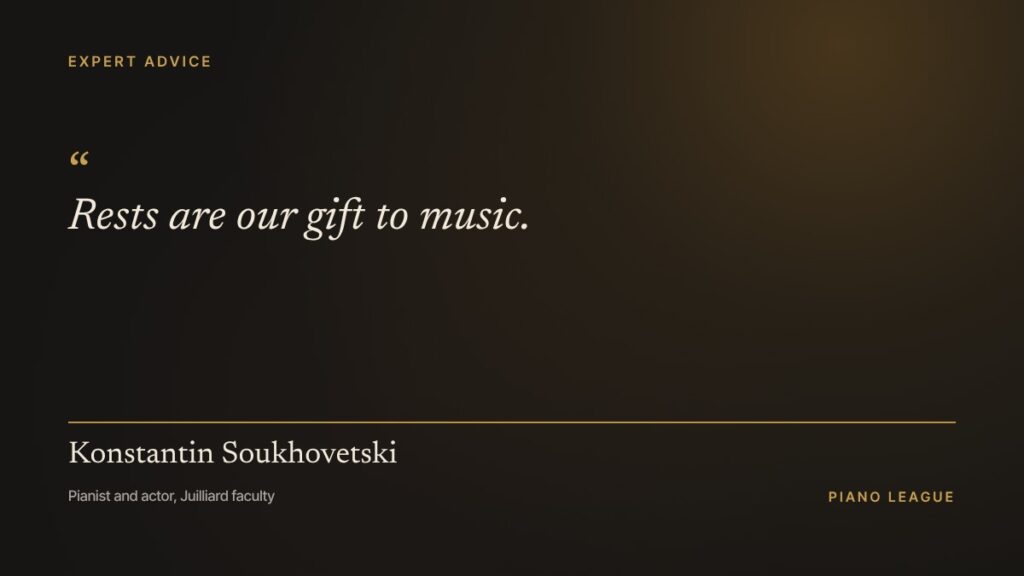
Rests are our gift to music. There’s a saying that the word is silver but silence is gold. So silence is gold. Silence is so rich. It’s where the music comes from, it’s where the words come from. So enjoy the rest.
Konstantin Soukhovetski
6. Practice with exaggerated rests
Sometimes when you shorten the rests, the more you cut the rest, the more breathless the music becomes and it starts moving forward too fast. That’s how you get this out of control acceleration, and that eventually leads to mistakes. So there is a technical underpinning to wanting to be narrative, because the moment you let the music run away from you, you’re out of control, and usually you get faster and faster and the technique fails and then you play wrong notes. So the best remedy for that is practice with exaggerated rests. Listen to silences and don’t let your mind rush you. Hold it back.
Konstantin Soukhovetski
7. To stay in time, feel too slow
Here’s a tip: whenever you start feeling like it’s starting to go forward and you can’t quite control it, slow down. So make yourself feel like you’re pulling back enough to start feeling you’re going in slow motion. In reality you will be perfectly in time. So in order to stay on time, you need to have a perception of being too slow.
Konstantin Soukhovetski
8. Choose the character before you practice
As time goes by, I realized that what I did earlier on, I didn’t create determinations of what my character was right away. So I would practice something one way, but then I would realize that it needs to be played the other way. So I wasted hours and hours and hours of time practicing something with a different body language, with a different degree of muscular intensity that I will no longer use. So I have to throw that away and re-practice it in the way that is right for the piece, and of course that is twice as hard. Once you learn something, to unlearn something takes double the effort. So if you approach technique through the lens of narrative musicianship, you’re just saving yourself a whole lot of time and effort and the burden of having to redo things over and over again.
Konstantin Soukhovetski
9. Bracket the hand positions in your score
This is one of my favorite tricks in all of music and all of piano playing: find the units where your hand sits at its most natural position. And I like visual aids, so I use colored pencils, virtual or otherwise, and I bracket these things for myself, so I know I’m looking not at the long mass of black notes that look scary and awkward, but within that there are smaller units of very easy things that your fingers are already on.
Konstantin Soukhovetski
10. Get rid of tension first
Stiffness is our enemy in all performing arts, whether you’re a singer, an actor or pianist or percussionist or a violinist or tuba player. Tension is a killer, so we have to get rid of it, and we have to do meditation exercises, breathing exercises, whatever it takes to get rid of it.
Konstantin Soukhovetski
11. Make the concert hall your home
When I perform, I come to the theater, to the concert hall, hours and hours before, and I want to be there, live there. I always come literally three, four hours early and I bring my belongings with me, something that is mine, and I plant it somewhere so that this entire space becomes mine. It is no longer some concert hall somewhere. My bag is over there and my eyeglasses case is over here, and I inhabit the place as though I inhabit my home. So by the time the audience comes, I welcome them into my world as opposed to invading theirs.
Konstantin Soukhovetski
12. Bring the audience into your circle
In that exercise is the importance of making it yours, surrendering into that space and not being afraid of it enlarging. So as it gets bigger, so is your power over it, so that when finally you’re alone on the stage in front of all these people, you can bring them into that small circle, as opposed to trying to create a wall and say, oh my god, I’m afraid of you, you’re judging me.
Konstantin Soukhovetski
13. Learn the rules before you break them
Nothing should ever be gratuitous. If you’re choosing to ignore a marking, there needs to be a good enough reason to, and it may be a good reason. In fact, it may be for the better of the piece, but it has to be informed. It’s like Picasso: before he went into cubism, he drew beautifully. So in order to disregard the rules, you have to learn how to use them first.
Konstantin Soukhovetski
Quotes are lightly edited for length and clarity. They come from Konstantin Soukhovetski’s 2020 Piano Star Masterclass on narrative musicianship. You can watch the full masterclass on the Piano League YouTube channel.
Have a story tip or a correction? Tell us.