
Leann Osterkamp on why practicing hands separately turns one piece into three
The pianist on learning a new piece: read it through first, mark what is easy, and leave your ego offstage.
Leann Osterkamp is a pianist and Steinway Artist who recorded the complete solo piano works of Leonard Bernstein for the Steinway & Sons label. A U.S. Presidential Scholar in the Arts, she taught for more than five years in the Keyboard Studies Department at The Juilliard School.
Here are fourteen of her best tips, from her Piano Star Masterclass on practicing new repertoire on Piano League.
1. Don’t start hands separately
We don’t want to play hands separate right off the bat. It’s always a tendency that we want to just memorize the left hand and memorize the right hand and then try to put everything together. And what happens when we do that is that we end up creating three times as much work, because we end up learning three separate pieces. So when you’re just starting a piece, in my opinion, I think the only really important use of hands separate is fingering.
Leann Osterkamp
2. Plow through it first
I think the most important thing to do, before you start really getting into the nitty-gritty practicing, is to just plow through it, to try to play through the piece. Ignore your mistakes, do your best to just kind of sight read through it. And the reason this is so important is that you really get a flavor from what you’re going to experience. It really helps you create and map a game plan for what you’re going to do.
Leann Osterkamp
3. Mark what is easy and what is impossible
Read through the piece again, but this time, instead of stopping and starting everywhere, I want you to make note of where you can play through completely easily already. Maybe there’s parts and measures that are 100% sight-readable for you, and then parts that maybe are impossible, like you can’t even get through the whole measure, you just gotta skip it.
Leann Osterkamp
4. The whole piece isn’t hard
The more that we go through and we look for stars and smiley faces, a lot of times that’ll show you that there’s one or two very specific things that are hard about a piece for you. So I kind of find this as a really optimistic way of practicing, because it’s really easy for us as musicians to be hard on ourselves, especially at a beginning stage of a piece, and get frustrated. And how many times did you just say, hey, I’m not going to learn this, it’s too hard? Instead what this is doing is it’s showing you the whole piece isn’t hard. It’s just that maybe one or two techniques in the piece are.
Leann Osterkamp
5. Ask yourself why it’s hard
You want to go back and say, why is that hard? And that’s kind of the part that you want to engage with your teacher, but it’s also important to kind of think about it yourself, because the ultimate goal with piano or any instrument is to be able to teach yourself at some point.
Leann Osterkamp
6. Spend your time where the work is
Maybe you have a job on the side, maybe you do something else, and so you don’t have the time to spend eight hours a day playing the piano. Spend your time focusing on one or two technical elements in a piece at the very beginning, and you’ll find that you’ll go from sight reading to really kind of playing through it at a much faster level, because you’re targeting the areas that need the work, not just trying to start at the beginning and then stopping every time you make a mistake.
Leann Osterkamp
7. You don’t have to start at the beginning
You don’t have to always start at the beginning. That’s the other big, big message to take away from this. We can actually start learning a piece at the end, we can start in the middle, we can just target specific types of techniques.
Leann Osterkamp
8. Leave your ego out of it
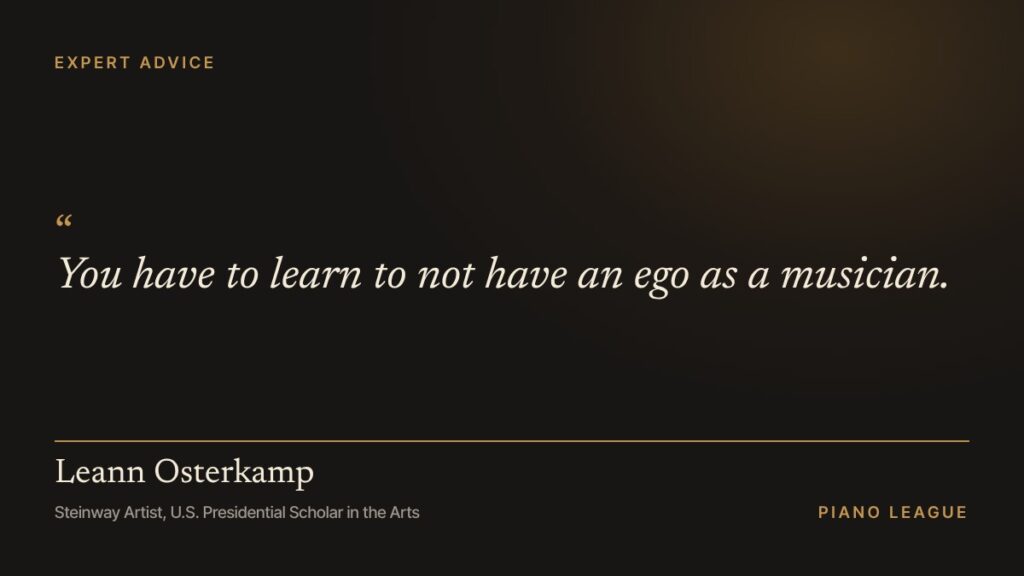
You have to learn to not have an ego as a musician. Instead it’s really about accepting that music is a lifelong learning process. So you have to be able to play in front of colleagues or peers or your family or your friends and be willing to make those mistakes, because it’ll actually save you a lot of time in your practicing, and it’ll make you more confident for when the stakes are a lot higher.
Leann Osterkamp
9. Predict what will go well
The number one thing that you want to do, I think, before you perform for your friends or your family or anyone that kind of gives you that little bit of extra stress, is I want you to write down a list, and I have all of my advanced piano students do this, of things that you think will go well and things that you think will not go well.
Leann Osterkamp
10. Alternate detailed days and broad days
When you’re preparing for a concert, alternate the days that you do really detailed work and days that you do broad work. It’s really easy to get so concerned about one measure or about one passage or about one piece that you end up kind of forgetting about the broader musical purpose.
Leann Osterkamp
11. Play it in the middle of the night
You want to try to mix it up. So if I’m preparing for a very high-stakes concert or competition, I try to mix it up where I’ll start in completely random places in the piece. Sometimes I would wake myself up in the middle of the night to try to just wake up groggy and try to play through it and see what happens.
Leann Osterkamp
12. Write down your first adjectives
Think about, first of all, adjectives that you might have. What just came to your mind, what was sparked in your imagination? I tend to like to just kind of write some of that down in a journal. Sometimes I’ll write it right on the music. Maybe you experience the piece as very wistful, maybe it was exciting, maybe it was romantic, just anything that comes to your mind, even if it’s silly.
Leann Osterkamp
13. Read big chords left hand, right hand, play
Instead of trying to read three notes at the same time, which will often end up in us playing at least one of the notes maybe wrong, always read left hand, right hand, play.
Leann Osterkamp
14. Treat your pieces as lifelong friends
When you really have that perspective that these pieces are lifelong friends that you’re going to keep revisiting, it really takes pressure off, that nothing has to be absolutely perfect at that exact moment, because it can’t be. It’s something that you’re going to live with.
Leann Osterkamp
Quotes are lightly edited for length and clarity. They come from Leann Osterkamp’s 2020 Piano Star Masterclass on practicing new repertoire. You can watch the full masterclass on the Piano League YouTube channel.
Have a story tip or a correction? Tell us.